Saafu Ukulhas 2026 — When a Predictable Event Meets an Unprepared System

A simple truth sits quietly beneath this year’s Saafu Ukulhas.
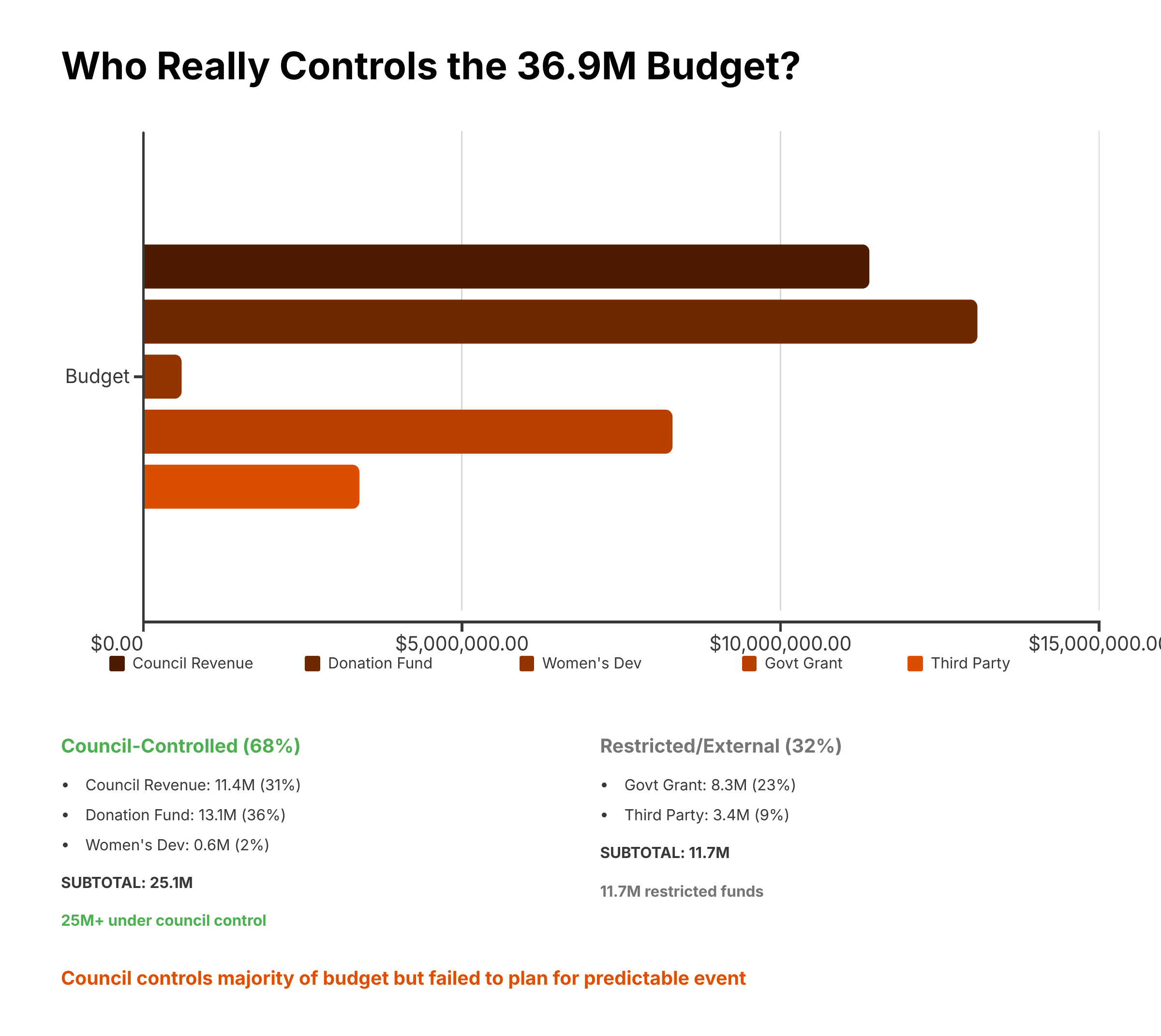
The Council manages MVR 36.9 million in 2025 —
with more than 25 million rufiyaa under its direct control for community priorities —
yet a predictable annual event still arrived at operators’ doors as a last-minute request during the busiest weeks of the tourism season.
This is not a debate about the value of Saafu Ukulhas.
The island supports it.
The event belongs to the community.
The intention is shared.
The question is softer, but heavier:
Why did an island with this level of resources need emergency fundraising for something that happens on the same date every year?
This is not a resource shortage.
It is a planning problem.
1. The Island’s Budget Reality
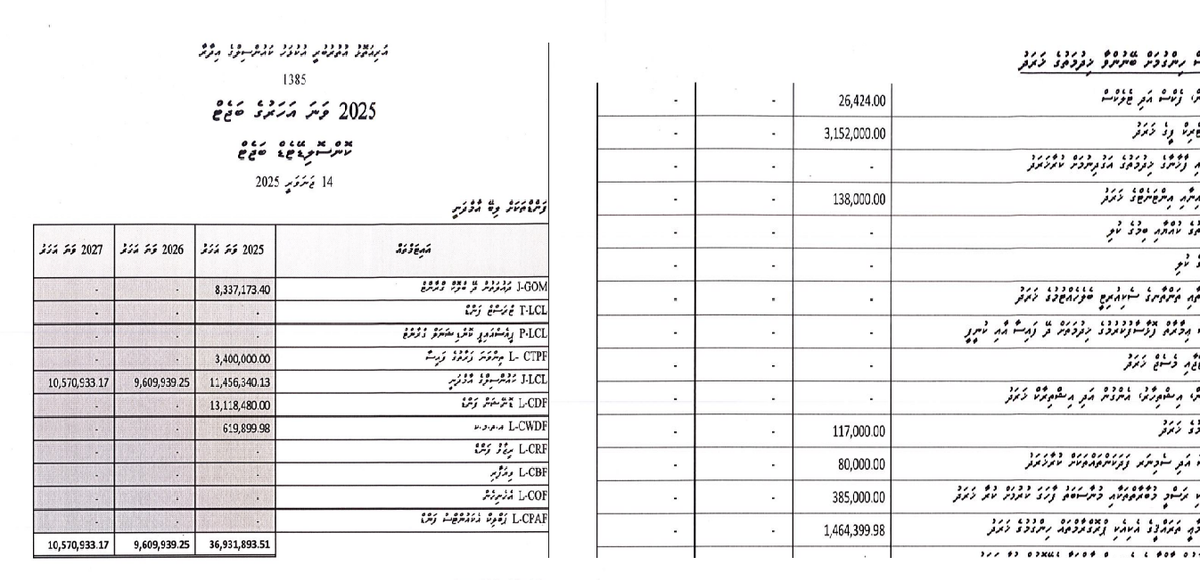
Ukulhas Council’s 2025 budget totals MVR 36,931,893.51.
The numbers reveal a structure beneath the complexity:
Revenue Sources
- Government Block Grant (J-GOM): 8.3M
- Council’s Own Revenue (J-LCL): 11.4M
- Community Development Fund – CDF (L-CDF): 13.1M
- Third-party funds (L-CTPF): 3.4M
- Women’s Development Fund (L-CWDF): 619K
The council directly controls more than 25 million rufiyaa each year — a significant amount for an island of this size and tourism density.
Resources are available.
The question becomes: where do they flow?
2. How the Budget Moves Through the Year
A closer look shows the forces that shape day-to-day governance:
Recurrent Expenditure — 19.1M
- Personnel salaries & allowances: 9.0M
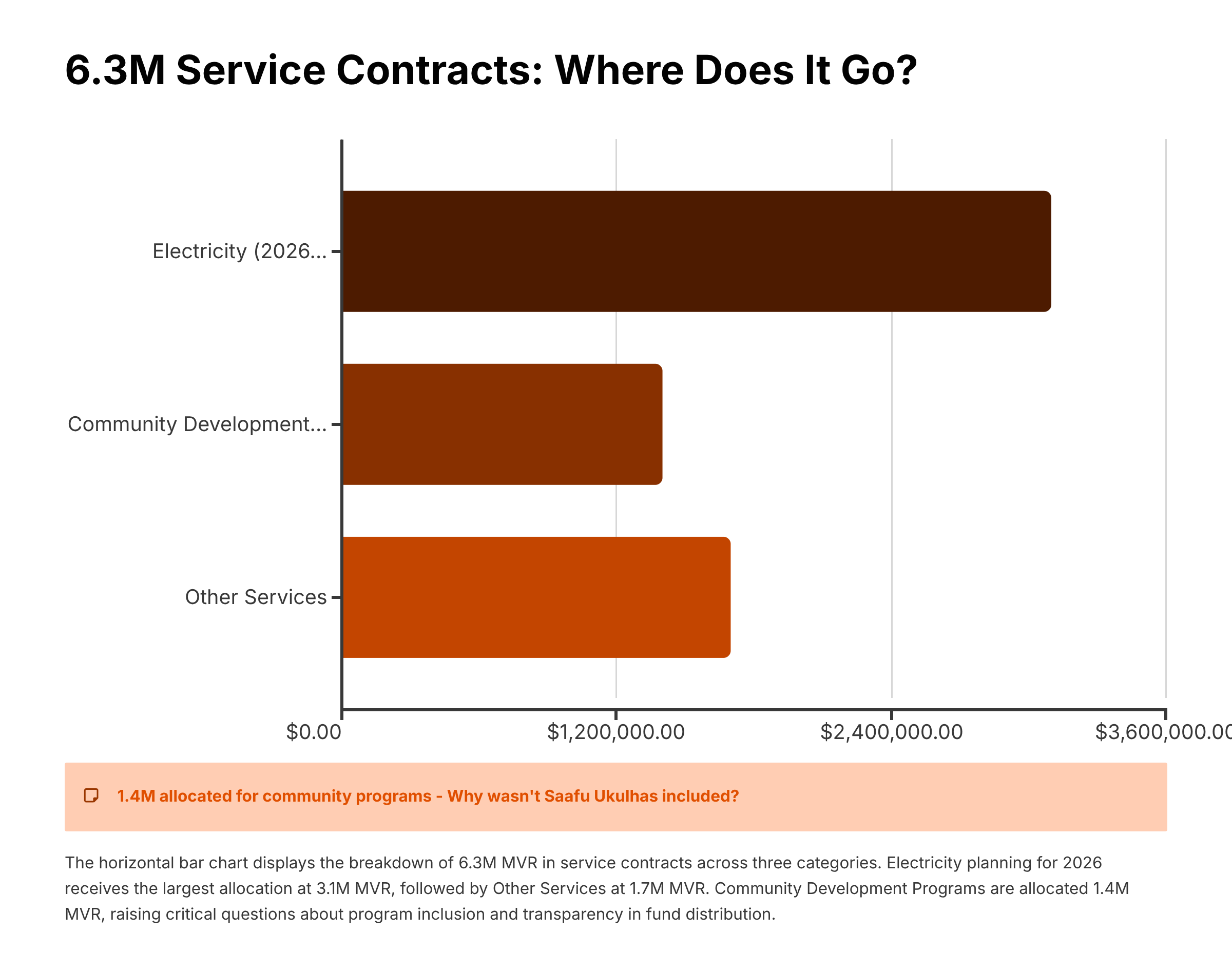
- Service contracts: 6.3M
- Electricity (2026 obligation planning): 3.1M
- Community development programs: 1.4M
- Other contracted services: 1.7M
- Building & facility maintenance: 2.4M
- Other recurrent operations: remainder
Here one detail matters quietly:
The council budgeted ahead for the January 1, 2026 electricity transition, when STELCO ends its CSR subsidy and the council begins paying domestic rates.
This forward planning shows something important:
The council can plan for predictable obligations —
which makes the Saafu Ukulhas funding gap more notable.
Capital Expenditure — 11.2M (PSIP)
Central government projects.
The council implements, but does not decide these allocations.
Other Capital & Facilities — ~3.1M
Machinery, IT assets, furniture, building upgrades.
The structure is clear:
high fixed costs, significant resources — and space for community programs if planned properly.
2.5 The Council Has a Strategic Plan — But Doesn’t Follow It
There is another quiet layer beneath the budget.
Ukulhas Council published a 2022–2026 Strategic Financial Plan — a document outlining expected income, spending priorities, and long-term targets.
The issue is not absence of planning capacity.
The issue is the gap between strategic plans and actual decisions.
A few variances stand out:
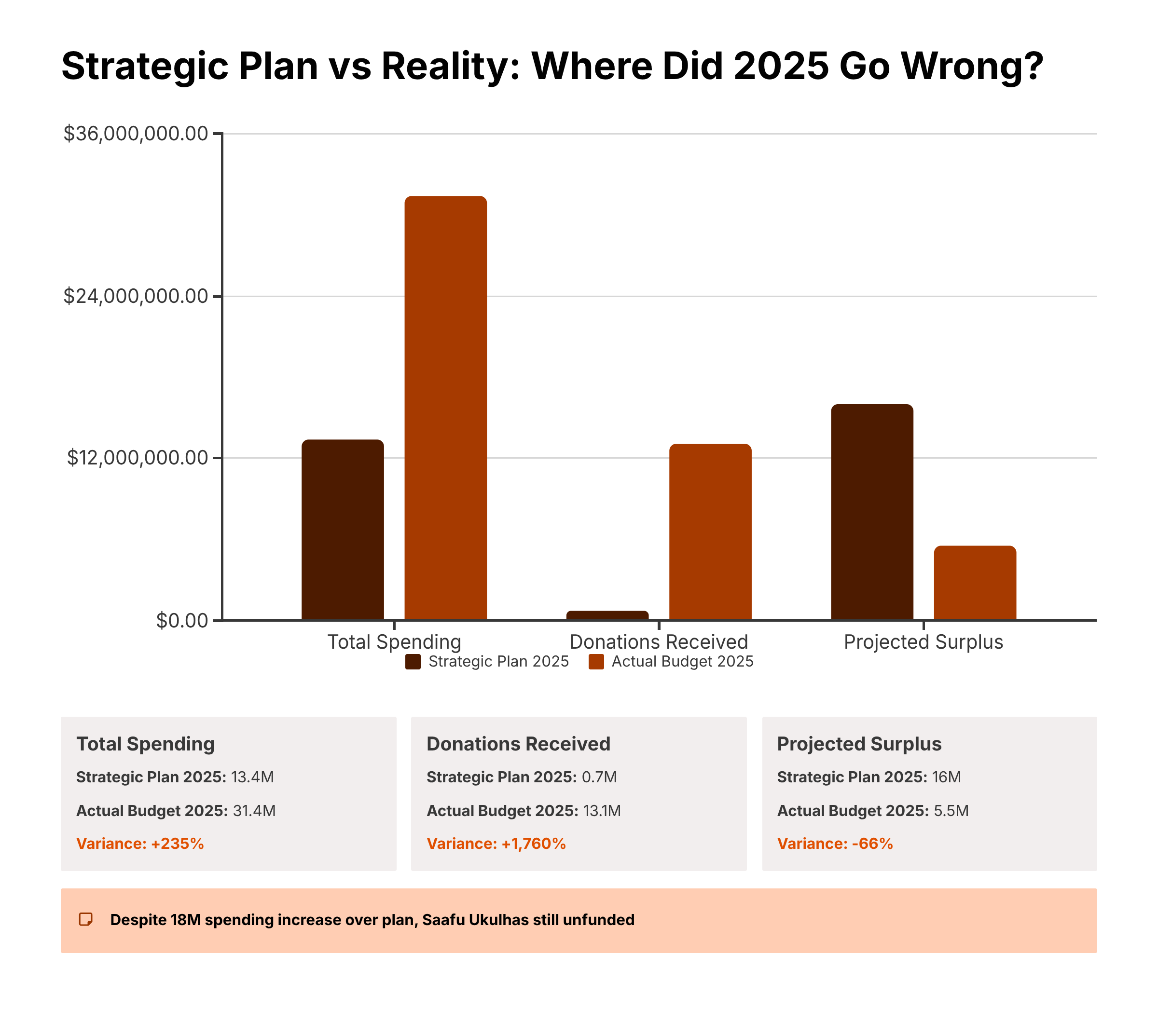
- Planned 2025 spending: 13.4M
Actual spending: 31.4M
(a 235% variance) - Planned donations: 745,000
Actual donations received: 13.1M
(a 1,760% variance) - Planned 2025 surplus: 16M
Actual surplus: 5.5M
Despite an 18M increase in spending over plan —
a predictable annual event still arrived unfunded.
The plan also sets internal spending rules:
- Target: keep recurrent spending below 70% of block grant
Actual: recurrent spending equals 230% of block grant (19.1M vs 8.3M) - Rule: 5% of donations should support women’s development
Actual: 4.7% (619K of 13.1M)
The council's 2026 budget projection reveals another layer of this planning challenge.
The mid-range estimate projects only 9.5 million rufiyaa in guaranteed funding-based solely on the government block grant.
No projection is made for:
- the 13.1M in donations that arrived in 2025
- the 11.4M in council revenue collected in 2025
- the 28M+ in non-grant income that comprised 77% of actual 2025 resources
This conservative approach may reflect fiscal prudence.
But it also underscores a larger truth:
When two-thirds of the budget depends on variable, unpredictable sources,
planning for recurring commitments becomes more essential — not less.
Predictable events require predictable budgeting.
That discipline becomes more urgent, not optional, when base funding is uncertain.
None of this suggests wrongdoing.
But it reveals a deeper truth:
Ukulhas does not suffer from lack of planning capacity —
it suffers from planning that is not followed.
This is what makes the Saafu Ukulhas situation more than a timing issue.
It reflects a wider misalignment between strategy and execution.
3. The Community Development Allocation — and the Missing Event
Inside the 2025 budget lies 1.4 million rufiyaa allocated for community development programs.
This allocation is designed specifically for:
- community events
- awareness activities
- small recurring programs
- island-wide initiatives
Saafu Ukulhas fits naturally within this mandate.
Yet no public clarity exists on:
- how the 1.4M was used
- which projects consumed it
- who determines its priorities
- why this annual event was not included
This is not accusation.
It is a basic question of governance rhythm.
4. December Arrives — and the Island Is Already Carrying Its Heaviest Load
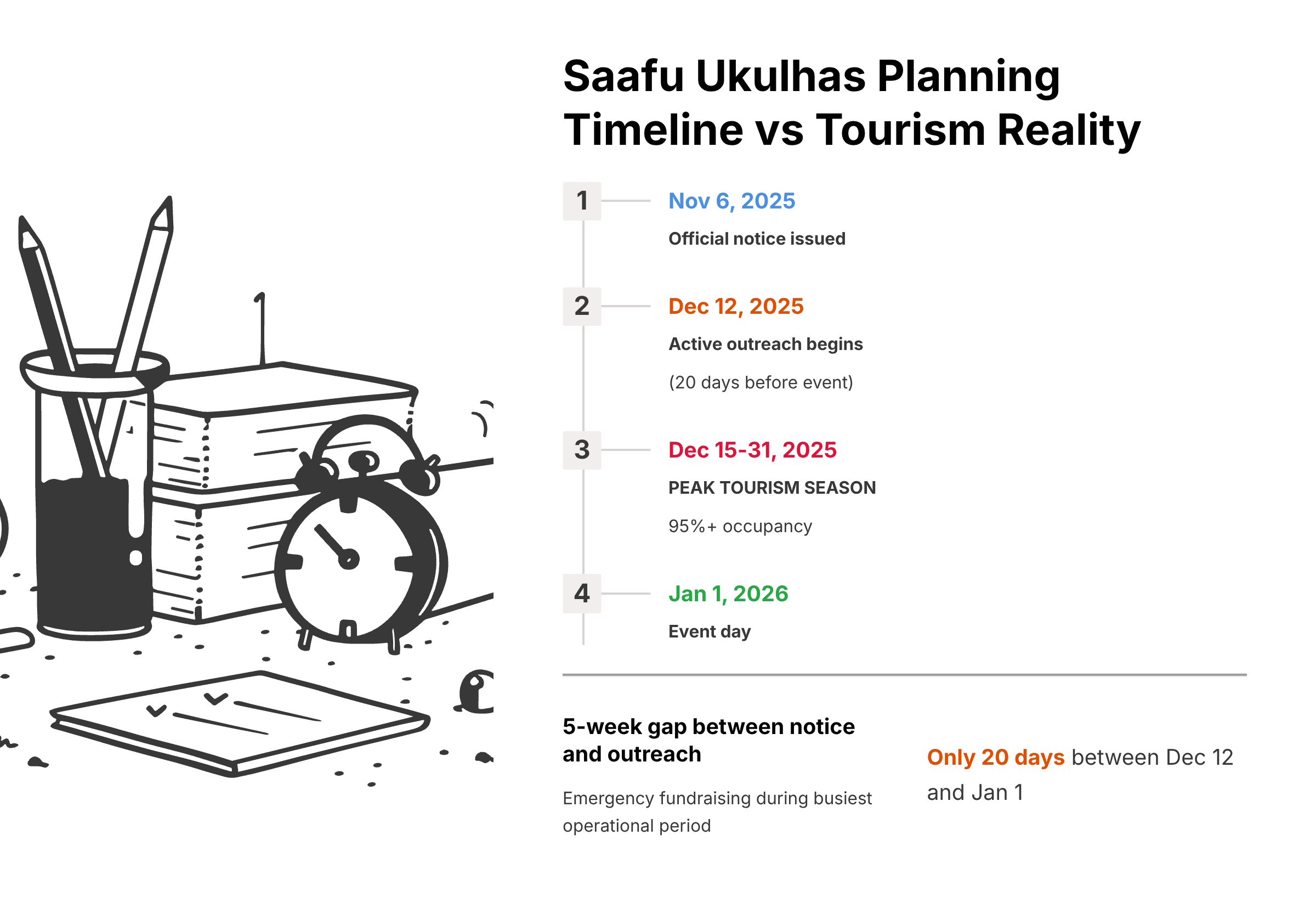
Though the council issued the Saafu Ukulhas notice on November 6,
active outreach to guesthouses began only on December 12.
For Ukulhas, December is not a slow month.
It is the island’s tightest operational window:
- 95%+ occupancy
- high staffing loads
- continuous excursions
- compressed schedules
- rising supply costs
- New Year’s Eve operations
- January 1 turnover from morning till evening
This is the period when operators have the least flexibility to respond to new demands — even for meaningful community events.
The issue is not unwillingness.
The issue is capacity.
Events respecting island rhythms require planning that arrives early, not during peak season’s narrowest space.
5. A Pattern Beneath the Surface
This is not the first time operators have observed similar gaps:
- unclear construction coordination
- delays in stakeholder communication
- mixed waste management performance
- contracting information not publicly detailed
- limited advance planning for shared community spaces
These do not point to lack of effort.
They point to systems still calibrated for a smaller island — one Ukulhas has already outgrown.
As the island scales, the systems beneath it must scale too.
6. Accountability Questions That Naturally Arise
These questions are not confrontational.
They are foundational for any public institution managing tens of millions of rufiyaa.
On Community Development (1.4M)
- What programs were funded in 2024–2025?
- Why wasn’t Saafu Ukulhas included?
- What criteria guide spending?
- Are performance reports published?
On Donation Funds (13.1M)
- What projects were supported using these funds?
- How were priorities determined?
- Could Saafu Ukulhas qualify under the CDF framework?
On Service Contracts (6.3M)
- What are the 1.7M in “other services”?
- Were contracts competitively bid?
- What performance benchmarks exist?
On Strategic Plan Compliance
- What explains the 235% variance from the council’s own plan?
- Who approved deviations from the 5-year strategy?
- Why were targets set if they were not followed?
- How does the council reconcile strategic projections with actual outcomes?
On Event Planning Itself
- Why did outreach begin during peak tourism weeks?
- Why was there a 5-week gap between the November 6 notice and December 12 engagement?
- What planning structure will be used for future annual events?
These are not aggressive questions.
They are invitations for clarity.
7. The Island’s Scale Now Demands a New Planning Rhythm
Ukulhas is no longer a small guesthouse island.
It is becoming a destination with:
- thirty-plus properties
- rising visitor expectations
- expanding infrastructure
- accelerating construction
- operational pressure across the year
Events that once relied on informal coordination now require:
- pre-budgeting
- earlier timelines
- sector-wide communication
- transparency around allocations
- predictable structures aligned with tourism cycles
It is the natural progression of a growing island.
Ukulhas has reached the moment where planning must evolve.
Closing Reflection — and an Invitation
Saafu Ukulhas remains a cherished moment in the island’s calendar.
Nothing in this article questions its value or the commitment of those who make it happen.
But the island is changing.
Its systems must match its scale.
The council is respectfully invited to respond to the specific budget and planning questions listed above.
Any clarification will be published in full.
Because accountability and partnership are not opposites.
They are the foundation of shared responsibility —
the way strong islands remain whole as they grow.
Ukulhas has the resources.
Now it must refine the rhythm that turns resources into readiness.