
Seasonality Isn’t a Dip — It’s a Cliff

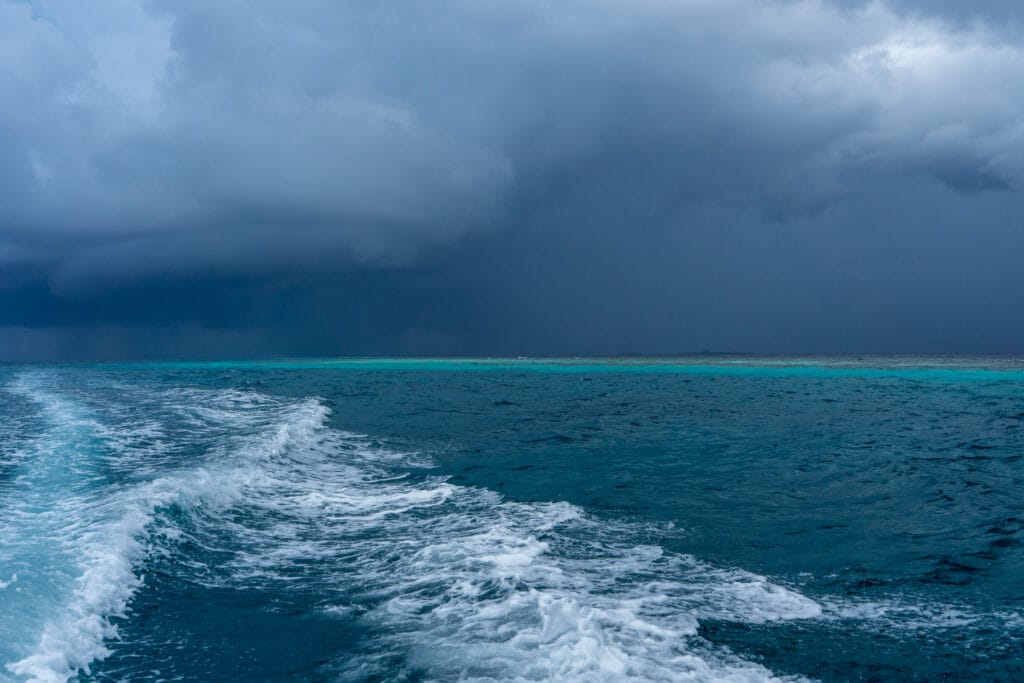
In most hotel management textbooks, seasonality is described as a gentle curve.
Demand softens, pricing adjusts, occupancy dips, and hotels use slow periods for training and maintenance. A predictable, manageable cycle.
But on small islands like Ukulhas, Mathiveri, Thoddoo, Feridhoo, or Rasdhoo, seasonality doesn’t behave like a curve.
It behaves like a cliff.
One month the island is full — the next month demand doesn’t soften.
It falls off the edge.
And during the southwest monsoon, many markets simply stop traveling to the Maldives altogether — not because of price, but because weather patterns shift traveler behavior.
This single difference reshapes everything: pricing, staffing, cash flow, marketing, online visibility, community resilience.
And it’s the reason traditional hospitality theory cannot explain — or solve — seasonality in the Maldives.
Here’s what it looks like in reality.
1. Islands Cannot “Close for Low Season” — Even If They Want To
In cities or resort clusters overseas:
- hotels close temporarily,
- staff find seasonal work,
- fixed costs shrink,
- utilities are centralized,
- the business simply pauses.
On islands, nothing pauses.
You cannot shut down desalination.
You cannot pause electricity.
You cannot stop waste collection.
Staff cannot “go home” for two months — this is their home.
And if you go inactive on OTAs, your ranking collapses.
A property that closes for three months often returns to find it has dropped from page 1 or page 2 to page 3 or lower — a position that can take months to recover.
So operators stay open not because it is profitable,
but because closing is worse.
Yet despite this pressure, island operators consistently find ways to endure low season — often through informal credit, community coordination, family support, or simply refusing to give up.
Seasonality isn’t a gentle slowdown.
It is a forced choice between two losses.
2. Fixed Costs Don’t Shrink, Even When Occupancy Does
Textbooks assume:
- lower occupancy → lower operating costs
- utilities drop
- staffing scales
- maintenance pauses
But on small islands:
- desalination runs regardless
- generators run regardless
- waste management runs regardless
- payroll continues
- bank loans continue
- rent continues
Even at 20% occupancy, you operate 100% of your infrastructure.
Your cost curve is flat.
Your revenue curve is a cliff.
And the gap between those two lines is where most guesthouses bleed.
3. Seasonality Isn’t Just Revenue Loss — It’s a Visibility Spiral
This is the part hospitality textbooks never cover, because it only exists in OTA‑dependent island markets.
Low occupancy means:
- fewer clicks,
- fewer interactions,
- fewer impressions,
- lower conversion,
- reduced ranking,
- even fewer impressions the next month.
It becomes what I can only describe as a visibility spiral — harder down than up.
Once a property drops from page 1 to page 3, the climb back up can take months — long after high season returns.
Seasonality is not only the fall.
It is the climb back up.
4. Small Inventory Amplifies Every Shock
This is the mathematics Western models never accommodate.
If you have 200 rooms:
- losing 40 rooms is painful but manageable.
If you have 6 rooms:
- losing 3 bookings = losing half your business
- one cancellation = an entire day’s revenue gone
- two no‑shows can destroy the week
- a 40% occupancy month means 2–3 occupied rooms — barely enough to justify running a kitchen, breakfast service, or staffing levels
Micro‑inventory is not a smaller version of big‑inventory economics.
It is a fundamentally different economic organism.
Variance hits harder.
Seasonality hits hardest.
5. Seasonality Affects Culture, Not Just Cash Flow
During low season, the guest count drops —
but the work does not.
Breakfast still needs to be prepared.
Rooms still need to be cleaned.
Service must remain consistent, personal, warm.
The cook still wakes before dawn to make:
- roshi with the right softness,
- mashuni with the right balance of lime and onion,
- rihaakuru mixes the way Maldivians expect.
These are not standardized recipes from a hotel manual.
They are cultural dishes passed through memory, repetition, and mentorship.
Even if only one or two rooms are occupied, hospitality remains cultural — not scaled, not diluted.
Seasonality drains numbers.
It also tests morale, energy, and community endurance.
6. The Cliff Reveals Why Islands Need Their Own Theory
Seasonality in archipelagic tourism is not:
- a curve,
- a pattern,
- or a predictable dip.
It is a cliff shaped by:
- geography,
- flight patterns,
- monsoon cycles,
- algorithmic systems,
- micro‑inventory,
- infrastructure rigidity,
- mono‑economy dependency.
And critically, it is a structural constraint — not a pricing problem.
Western pricing logic suggests:
- discount in low season
- stimulate demand
- capture more share
But on islands:
- the market itself shrinks
- travelers aren’t flying
- visibility drops
- demand becomes inelastic
A discount cannot generate demand that does not exist.
I’ve seen properties drop from USD 80 to USD 45 during monsoon season — and still sit at 15% occupancy.
The discount didn’t create travelers.
It only meant the few bookings that did come earned half the revenue needed to cover fixed costs.
Lowering rates in July does not create tourists in July.
It only erodes margins and delays recovery.
Western models assume:
- buffers islands don’t have,
- mobility islands don’t possess,
- curves islands don’t experience.
When we apply those models here, we misinterpret:
- pricing behavior
- operational fragility
- visibility loss
- capacity decisions
- staff stability
- community pressure
What Comes Next
In the next post, I want to explore The Fixed Cost Trap — why islands stay open even when they’re losing money, and why even “high occupancy months” don’t always translate into real profitability for micro‑properties.
Because seasonality explains when islands struggle.
Cost structure explains why they struggle.
And together, they reveal a deeper truth:
Small islands need their own economic frameworks — not borrowed ones.