The Copy Effect: How Ukulhas Stopped Leading and Started Following

There’s a pattern I’ve noticed on Ukulhas — and once you see it, you can’t unsee it.
The environmental sector on this island was built through innovation.
The tourism sector today is being built through replication.
Same island.
Same people.
Two completely different approaches — two completely different outcomes.
I’ve started calling this the Copy Effect, and I think it explains why Ukulhas, despite doing so many things right, still struggles with economic fragility in tourism.
When Ukulhas Used to Lead
Not long ago, Ukulhas was the island others came to study.
What the community built during those years was remarkable:
- The first Maldivian island to win the President’s Green Leaf Award
- One of the earliest community-driven plastic reduction initiatives
- Saafu Ukulhas, a grassroots cleaning movement
- A waste management model later adopted by other islands
- A reputation for doing things early, thoughtfully, and collectively
Ukulhas wasn’t following trends.
It was setting them.
Delegations visited to learn:
- how community cleaning worked
- how plastics were restricted
- how waste collection was organized
- how the island stayed so clean despite its size
For almost a decade, Ukulhas didn’t copy.
It led.
Then Tourism Arrived — and the Pattern Reversed
When the first guesthouses opened, they were distinctive — family-run, personal, rooted in stories and relationships.
But gradually, the model shifted.
Not deliberately.
Not maliciously.
Just the natural evolution of a small-island economy responding to visible success.
What unfolded:
- A few guesthouses succeeded → more opened
- A few cafés succeeded → more opened
- Excursion centres followed Maafushi’s full-service model
- Dive centres multiplied
- Restaurants offered similar menus
- Snorkeling trips ran identical routes
It wasn’t planned.
It was reactive.
A business model worked → so everyone repeated it.
The environmental sector thrived through coordinated innovation.
The tourism sector struggles through uncoordinated replication.
This is the Copy Effect.
A Scene That Made This Clear
One evening I stood at the harbor watching excursion boats return.
Four boats.
Nearly identical.
Offering nearly identical experiences.
At nearly identical prices.
A visitor beside me asked:
“Which operator is the best here?”
I couldn’t answer.
Not because all operators were equal — but because distinctiveness itself had disappeared.
An island that once built its reputation through uniqueness now risks blending into a tourism template copied from somewhere else.
Why Small Islands Drift Into Copying
This isn’t about people lacking imagination.
It’s about structural realities:
- Small market, limited demand
- High risk-aversion in tight-knit communities
- Low appetite for experimental businesses
- Success visibility — “if it worked for them, it will work for me”
- No island-level diversification strategy
Copying isn’t laziness.
Copying is survival logic.
But survival logic often produces fragile economies.
What Happens When Everyone Builds the Same Business
We see the results on Ukulhas today:
- Many excursion centres selling the same packages
- Restaurants with nearly identical menus
- Dive shops competing on price
- Guesthouses undercutting one another
- Excess supply concentrated in a few activities
- Margin erosion across the entire island
The environmental movement thrived because it was collective coordination.
The tourism economy struggles because it is uncoordinated replication.
Two very different systems.
Two very different outcomes.
A Harbor That Holds Two Histories
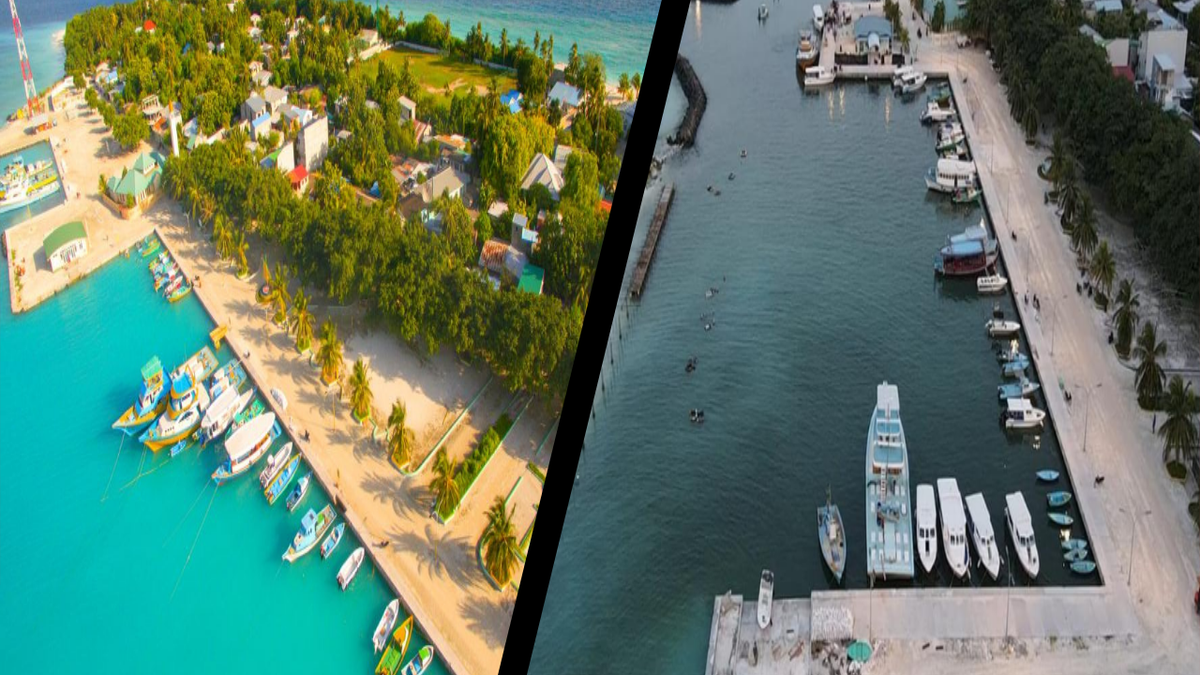
When I was younger, the harbor was full of fishing boats.
Fishing wasn’t just work — it was identity, rhythm, inheritance.
Today, the harbor is full of speedboats.
Again, not good or bad on its own.
Islands adapt. Economies evolve.
But the shift reveals something deeper:
Ukulhas once led. Today it imitates more than it creates — but it can lead again.
The Lesson Ukulhas Already Taught the Maldives
Ukulhas proved something powerful once before:
When a small island leads with intention, others follow.
Saafu Ukulhas, the plastic-ban efforts, the waste management system — these spread because:
- they were effective
- they were original
- they matched community values
Ukulhas can lead again — but only if it moves away from copying and back toward creating.
This Isn’t Blame — It’s Insight
People respond to incentives.
Families invest where they see opportunity.
Operators build what feels safe.
Communities follow whatever already works.
But now and then, islands must pause and ask:
What are we building?
And does it make us stronger — or more fragile?
If Ukulhas Wants a Resilient Tourism Future, It Must Do Again What It Did Before
Lead. Don’t follow.
- Create value, not just capacity
- Develop identity, not just inventory
- Encourage specialization, not uniformity
- Support owners who want to innovate
- Reward differentiation, not replication
Ukulhas already proved it can be a model.
The environmental story showed that clearly.
The tourism story can follow the same path — if the island chooses vision over imitation.
A Closing Thought
Diversification isn’t a luxury for small islands.
It’s a survival strategy.
When everyone builds the same business, the economy becomes shallow.
When even a few build something distinct, the island becomes resilient.
Ukulhas has led before.
It can lead again.
But only if it remembers what made it different in the first place.