
Why Hotel Management Textbooks Don’t Work in the Maldives

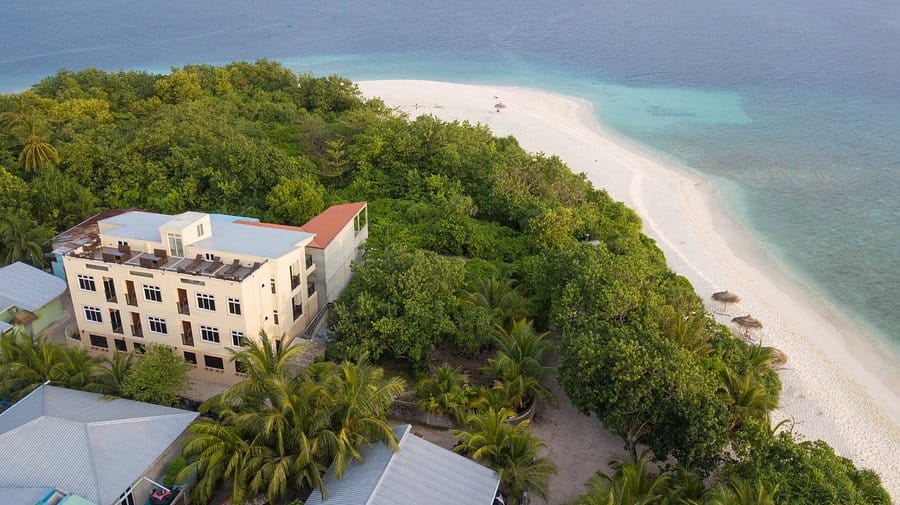
Most of the hospitality theory used in the Maldives today comes from Western hotel schools: revenue management, yield curves, segmentation, demand pacing, upselling strategy, occupancy thresholds, benchmarking, RevPAR, ADR, GOPPAR.
These models work beautifully — in the environments they were designed for.
But after 20 years working in Maldives tourism, both in resorts and guesthouses, I’ve learned that the logic inside those textbooks does not translate cleanly to tiny islands like Ukulhas, Mathiveri, Thoddoo, Maafushi, or any of the community tourism islands across the country.
Not because the books are wrong.
But because the context they assume does not exist here.
This isn’t a criticism of theory.
It’s the recognition of geography, scale, and reality.
Here’s why.
1. Western Hospitality Assumes a Connected Landscape
In hotel school, location is taught as a dynamic marketing factor:
- drive-by visibility
- walk-in traffic
- urban clustering
- proximity to commercial hubs
- competitive mapping
But in the Maldives:
Guests don’t “pass by” and choose you.
There is no walk-in traffic.
There is no spontaneous discovery.
No one wanders into a hotel by chance.
Arrival = commitment.
A tourist arriving in Ukulhas has already:
- chosen the island
- chosen the property
- purchased transfers
- committed time and cost
There is no such thing as location-based demand capture.
In island tourism, location is effectively static.
2. Western Pricing Models Assume Large Inventory
Revenue management is built around:
- 100+ room hotels
- predictable demand curves
- large sample sizes
- multiple room categories
- segmentation (business, leisure, group)
- continuous booking flow
But a guesthouse with 6–12 rooms is operating with micro-inventory.
Here’s how textbook logic collapses:
- One cancellation = 10–20% occupancy loss
- Two no-shows can destroy a week’s revenue
- Rate fences and aggressive dynamic pricing look predatory at the micro level
- Dramatic rate swings reduce algorithmic confidence in pricing
- Guests on OTAs see every rate change instantly
A theory designed for Marriott, Hilton, or Accor cannot scale downward to a 6-room island property where each room represents a double-digit slice of your business.
That’s not failure.
That’s mathematics.
3. Western Models Assume Diversified Economies
In Europe or Asia:
- A hotel can close for low season
- Staff find temporary work elsewhere
- Fixed costs can be paused
- Utilities run on national systems
- Banks understand seasonal revenue cycles
In the Maldives:
Islands cannot “pause.”
Staff live here — there is no alternative seasonal employment.
Electricity, desalination, and waste services run regardless of occupancy.
Debt payments do not stop.
A guesthouse that closes for months loses algorithmic visibility and ranking.
So small properties stay open even when staying open means losing money — because closing is worse.
Western textbooks assume economies with alternatives.
Small islands don’t have that luxury.
4. Western Service Models Assume Labor Mobility — Islands Do Not
Training manuals teach:
- “If a staff member leaves, hire another.”
- “Recruit from the wider labor market.”
- “Replace talent based on skill fit.”
But Maldivian island economies operate on a completely different logic.
Restaurants and cafés often hire Sri Lankan, Indian, Bangladeshi, Nepali, or Filipino staff. They are skilled and hardworking — but they do not arrive knowing Maldivian food culture.
This matters operationally.
Examples:
- Roshi (the thin Maldivian flatbread) requires a specific softness, stretching technique, and flipping rhythm that only a local can teach.
- Mashuni, kulhimas, rihaakuru mixes, garudhiya — these dishes don’t follow standardized recipes. They rely on taste memory, cultural intuition, spice balance, tuna cuts, and timing learned at home, not in culinary school.
Foreign chefs can learn these — but only after weeks or months of local mentorship.
So when one staff member leaves:
- menu consistency changes,
- breakfast quality shifts,
- the owner’s wife or mother steps in,
- or service becomes unstable until the replacement learns the cuisine.
In a city hotel, you hire a new cook by Friday.
On islands, one departure can destabilize an entire operation.
On islands, staff are not “resources.”
Staff are infrastructure.
5. Western Marketing Assumes Equal Visibility — Algorithmic Markets Do Not
Textbook marketing assumes:
- customers browse many options
- visibility is relatively equal
- price and quality compete on fair terms
In the Maldives today:
Visibility is algorithmic.
Large properties accumulate more booking data and more reviews.
More data = stronger signals → higher ranking.
Higher ranking = more clicks → more bookings → more data.
This becomes a self-reinforcing loop:
visibility → bookings → data → more visibility
Small properties lose not because they’re lower quality —
but because they produce less algorithmic signal.
Few mainstream hospitality textbooks address archipelagic visibility markets, because this problem doesn’t exist in Paris, Bangkok, Singapore, or London.
But it exists here.
6. Western Sustainability Models Assume Central Infrastructure
Sustainability courses often assume:
- national recycling systems
- centralized waste processing
- municipal water networks
- shared transportation grids
But in islands like Ukulhas, Thoddoo, Mathiveri, Rasdhoo:
- Waste is handled locally
- Desalination is local
- Power generation is local
- Recycling requires transport
- Carrying capacity is ecological and immediate
When textbooks say “scale sustainably,” they assume national infrastructure.
On small islands, the island is the infrastructure.
7. Western Tourism Assumes Multiplicity — Islands Experience Concentration
Elsewhere tourists move between cities, stay in multiple hotels, try different attractions.
Tourism is a flow.
In the Maldives:
A tourist chooses one island.
And that island becomes their entire world for 5–10 days.
Textbooks assume substitutability and movement.
Islands experience concentration.
That changes everything.
So What Does Work Here?
Not a rejection of Western theory.
A reinterpretation. A translation.
Frameworks suited to archipelagic realities:
- carrying-capacity economics
- visibility economics
- algorithmic demand formation
- micro-inventory pricing
- mono-economy fragility
- island systems thinking
- sustainability as infrastructure
These are the knowledge gaps almost no textbook addresses — because almost no textbook was designed for islands where:
- 5 rooms shape an economy
- 1 boat defines connectivity
- desalination limits growth
- reef health affects tourism
- algorithms allocate demand
- waste management is local, not national
- seasonality isn’t a dip — it’s a cliff
Understanding this gap is the first step toward designing models that actually work here.
Why This Matters Now
Islands like Ukulhas are entering a period of:
- rapid capacity growth
- increasing competition
- algorithmic dependence
If we keep applying frameworks built for 500-room city hotels to 8-room island properties, we will misinterpret:
- pricing behaviour
- seasonality
- demand shocks
- oversupply
- community fragility
- investor expectations
The problem is not the operators.
The problem is the model.
And this is why, in future posts, I want to explore alternatives — frameworks built not for global cities but for small islands shaped by sea, season, and scale.
Because if Ukulhas proved it could lead environmental systems,
there’s no reason it can’t lead economic systems too.